

counselling & creative embodiment
for big feelers, creatives, and those curious about (re)connecting to themselves and an embodied practice.

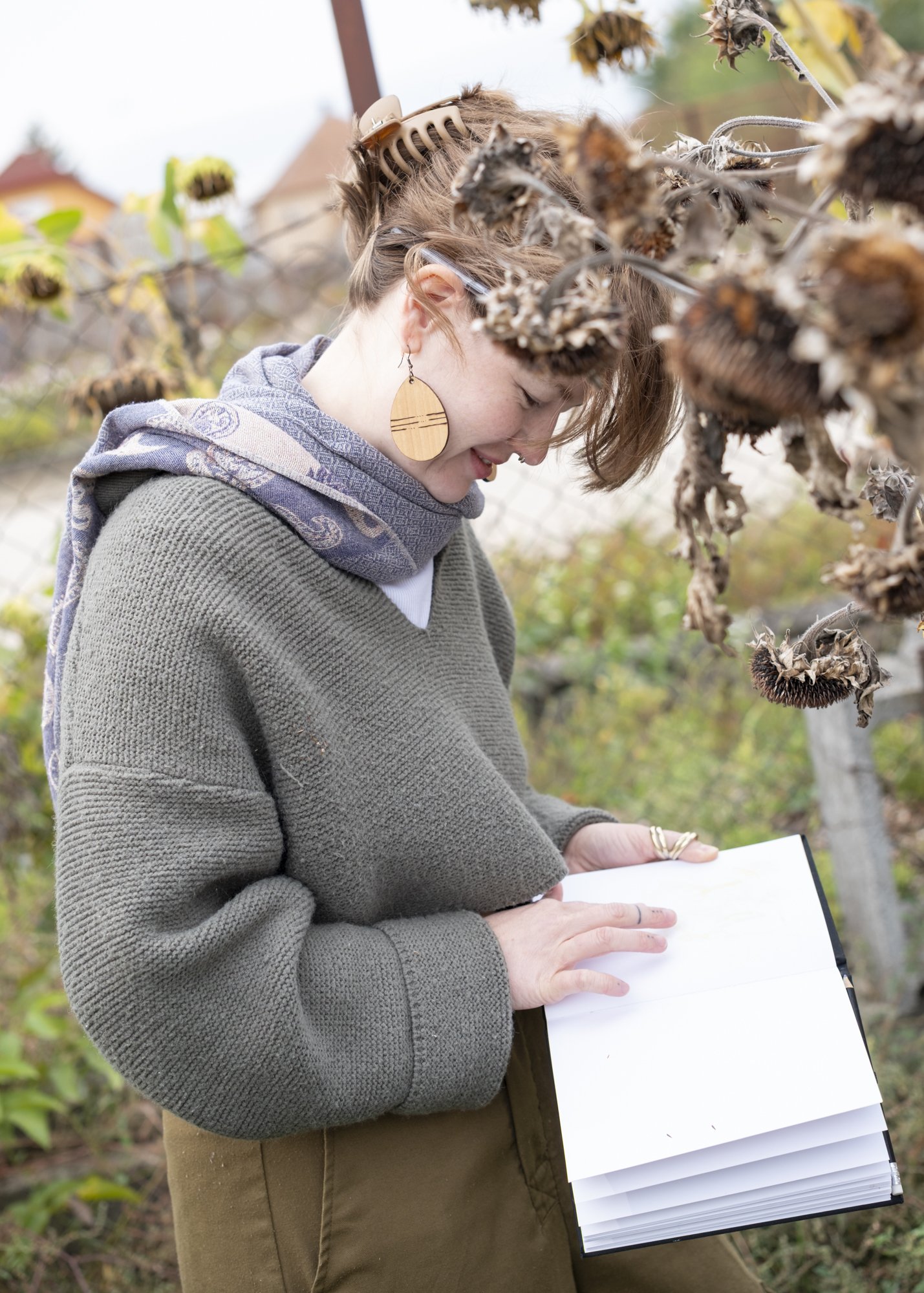
By Nagy Lili Panna at the School of Disobedience
My practice is rooted in process & sensory based inquiry that is meant to help guide those into a gentle awareness of ourselves and our bodies. Most of my work explores how sensation through the use of relational talk therapy, (eco)somatics and creative practices to help us to create meaning and connection to ourselves and the world we live in.
For many of us, when we have bodies that have experienced trauma, disenfranchisement, disability or detachment these sensations may feel unsafe to experience. Through practices of movement, creative prompts & eco-somatics we may be able to orient to a felt & embodied sense of safety and to co-create a more liberatory world.
Welcome to thorn & earth
-Alexandria
what is somatics and creative embodiment?
I view creative embodiment as an accompaniment to somatic inquiry. Somatic practices can be the initiator, the inquiry to sensation. Creative embodiment is the expression of it. Sometimes that is scribbling or moving our bodies. We find the sensation together, direct the impulse of expression and witness it.
It is a process and materials based inquiry that supports the somatic components.
Somatic practices are usually defined as a holistic approach of inquiry that focuses on the mind-body connection. Whereas eco-somatics is a field of research with emphasis on body and ecological awareness for embodied practices. It usually focuses on the present moment and how your body shows up and what sensations may arise and in relation to nature.
When the body senses and feels in the present and our mind can sometimes be thinking in the past or future, it can be tricky to navigate. When we try to label a feeling or sensation, moving to language or talk can often result in us moving away from the sensation. This is where I believe non-talk therapy practices can be supportive.
“We are all bodies of water.
To think embodiment as watery belies the understanding of bodies that we have inherited from the dominant Western metaphysical tradition. As watery, we experience ourselves less as isolated entities, and more as oceanic eddies: I am a singular, dynamic whorl dissolving in a complex, fluid circulation.”
Neimanis, Astrida. “Hydrofeminism: Or, On Becoming a Body of Water.”